Anahata ASI Whitepaper
The Architectural Blueprint of the World's First Pure-Java Artificial Super Intelligence Platform.
Core Architectural Thesis
Artificial Super Intelligence (ASI) cannot emerge as a stateless REST client or an external chat prompt. An intelligence becomes superintelligent only when endowed with an autonomous, stateful, thread-safe software substrate capable of continuous context window garbage collection, in-process bytecode compilation, compiler-level AST refactoring, and deterministic physical desktop actuation.
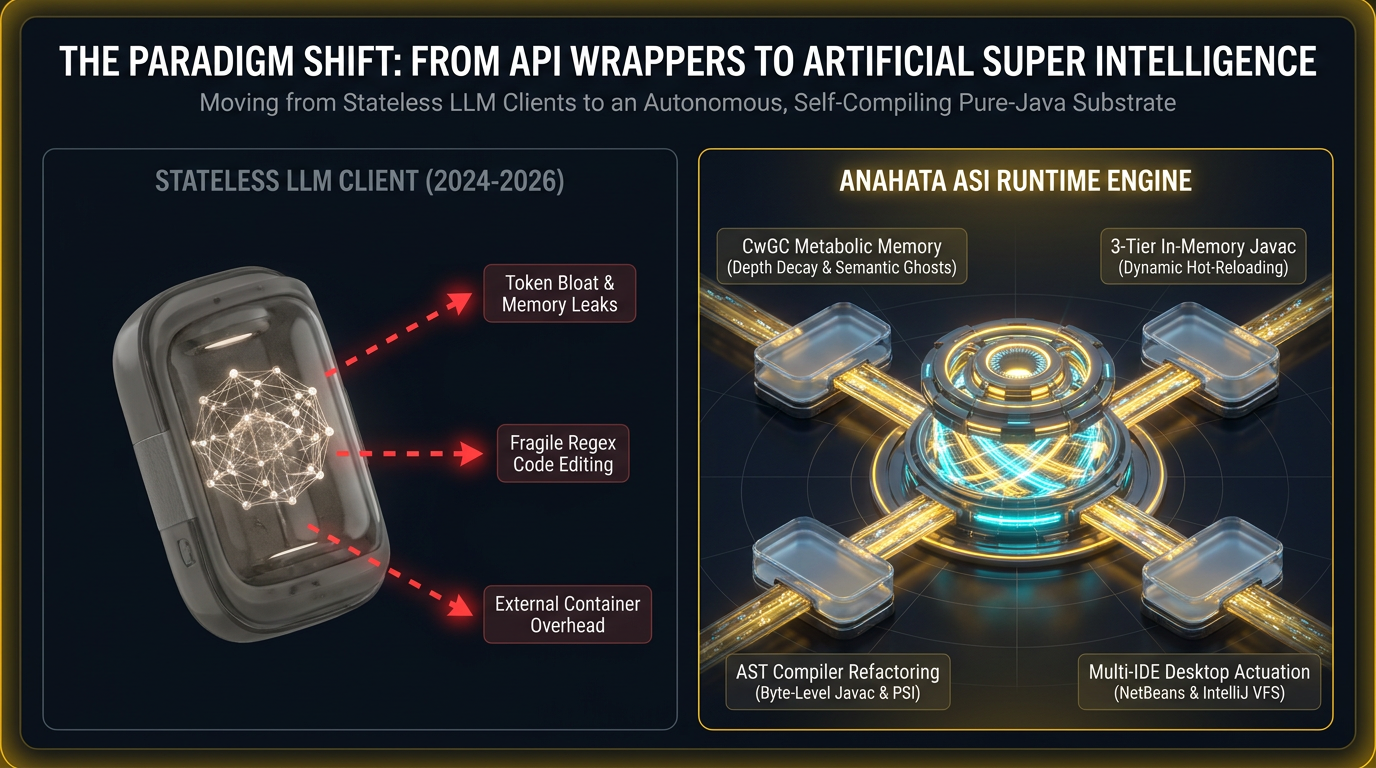
1. The ASI Paradigm Shift: Beyond the "Brain-in-a-Jar"
For decades, theoretical AI research has framed the transition from Artificial Narrow Intelligence (ANI) to Artificial General Intelligence (AGI) and Artificial Super Intelligence (ASI) as an inevitable consequence of raw model scaling. Yet in 2026, despite models boasting hundreds of billions of parameters and multi-million token context windows, enterprise AI remains severely bottlenecked.
The reason is architectural: an LLM is merely a reasoning engine—it is not an operating system. Without an execution substrate, an AI model is a "brain-in-a-jar": unable to remember past its context limits, unable to verify its assertions against a compiler, and unable to acquire new capabilities dynamically without manual human redeployment.
2. Deconstructing the "Big Five" Java AI Frameworks
Between 2024 and 2026, five major frameworks formed Java's response to Python's LangChain: Spring AI, LangChain4j, Spring AI Alibaba, AgentScope-Java, and Semantic Kernel. While each serves standard microservice requirements, they encounter strict architectural ceilings when tasked with long-running, autonomous agency:
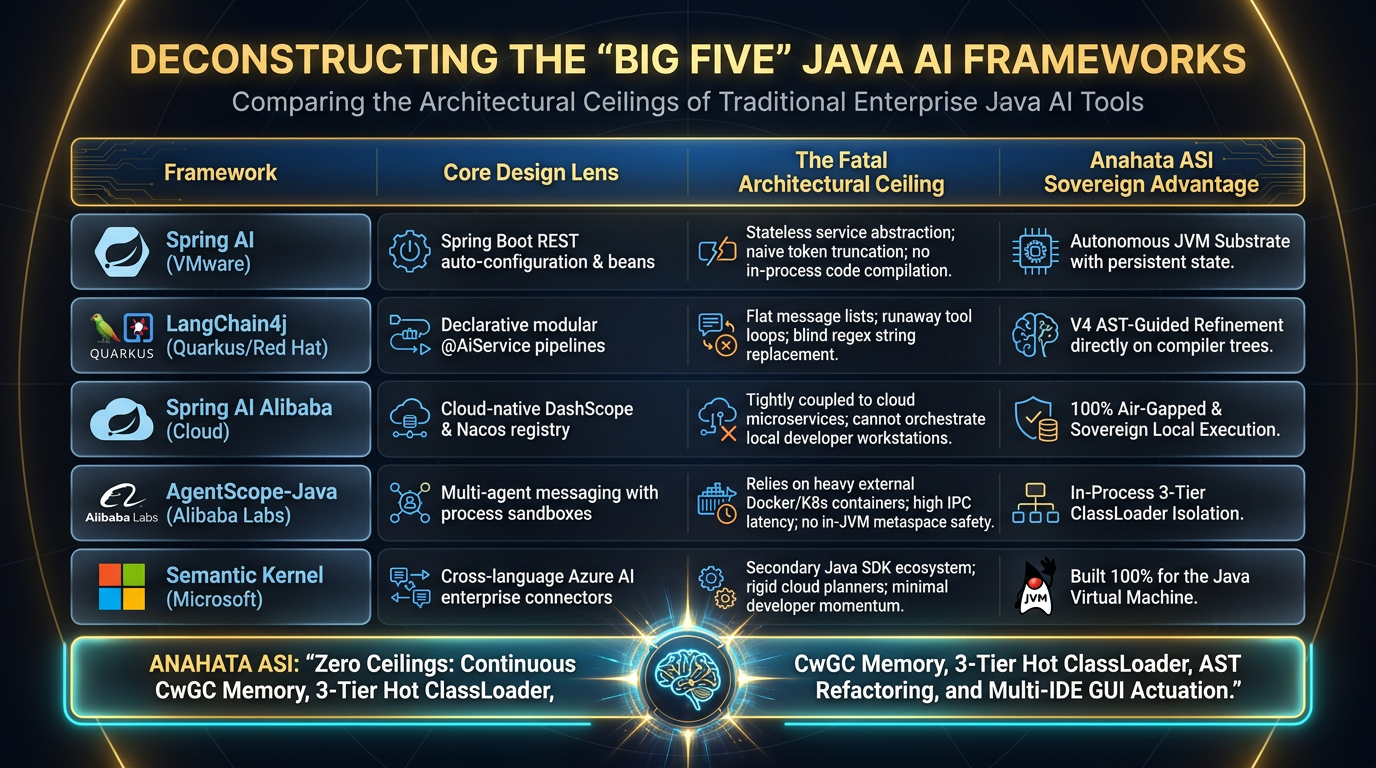
| Framework | Primary Design Lens | Fatal Architectural Ceiling |
|---|---|---|
| Spring AI | Spring Boot REST auto-configuration & beans | Stateless service abstraction; naive token truncation; no in-process code compilation; zero IDE integration. |
| LangChain4j | Declarative modular @AiService pipelines |
Flat message lists; runaway tool-call loops; blind text replacements; no compiler AST perception. |
| Spring AI Alibaba | Cloud-native DashScope & Nacos registry | Tightly coupled to Alibaba Cloud microservices; lacks local developer workstation orchestration. |
| AgentScope-Java | Multi-agent messaging with process sandboxes | Relies on heavy external Docker/K8s containers for execution; high IPC latency; no in-JVM metaspace safety. |
| Semantic Kernel | Cross-language Azure AI enterprise connectors | Secondary Java SDK ecosystem; rigid cloud planners; lack of developer community momentum. |
| Anahata ASI | Stateful ASI Container & Digital Organism | Zero Ceilings: Continuous CwGC memory, 3-tier hot classloader, V4 AST batch refactoring, and multi-IDE GUI actuation. |
3. Metabolic Memory: The Context Window Garbage Collector
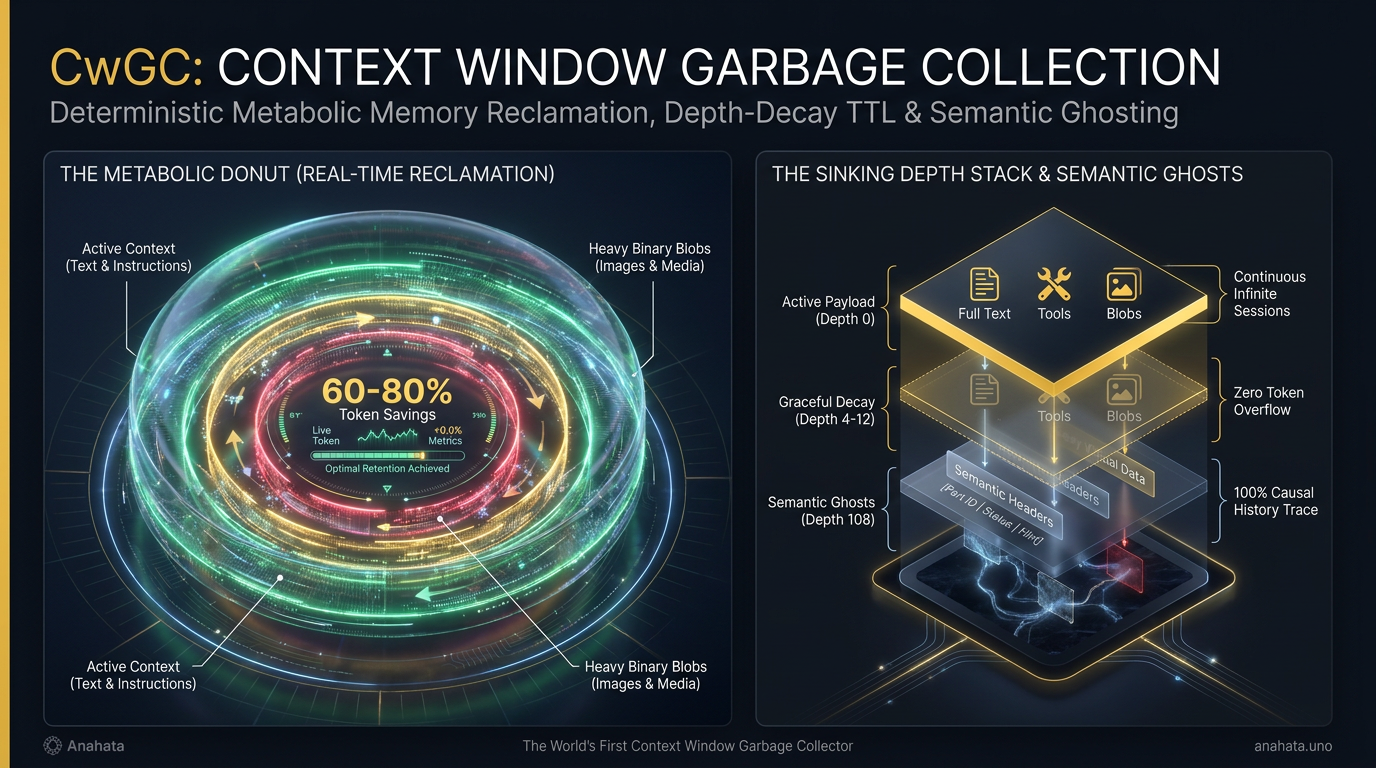
All conventional LLM frameworks face the Context Memory Paradox: unbounded message accumulation causes quadratic token costs and catastrophic context overflows, while naive sliding windows cause instantaneous cognitive amnesia.
Anahata invented the Context Window Garbage Collector (CwGC). Every message part maintains an independent Time-to-Live (TTL) depth counter:
4. The 3-Tier ClassLoader & The Singularity Loop
To achieve true Recursive Self-Improvement, the AI must possess the capability to compile, link, and execute arbitrary code without crashing the host application. Anahata implements a deterministic 3-Tier ClassLoader Hierarchy:
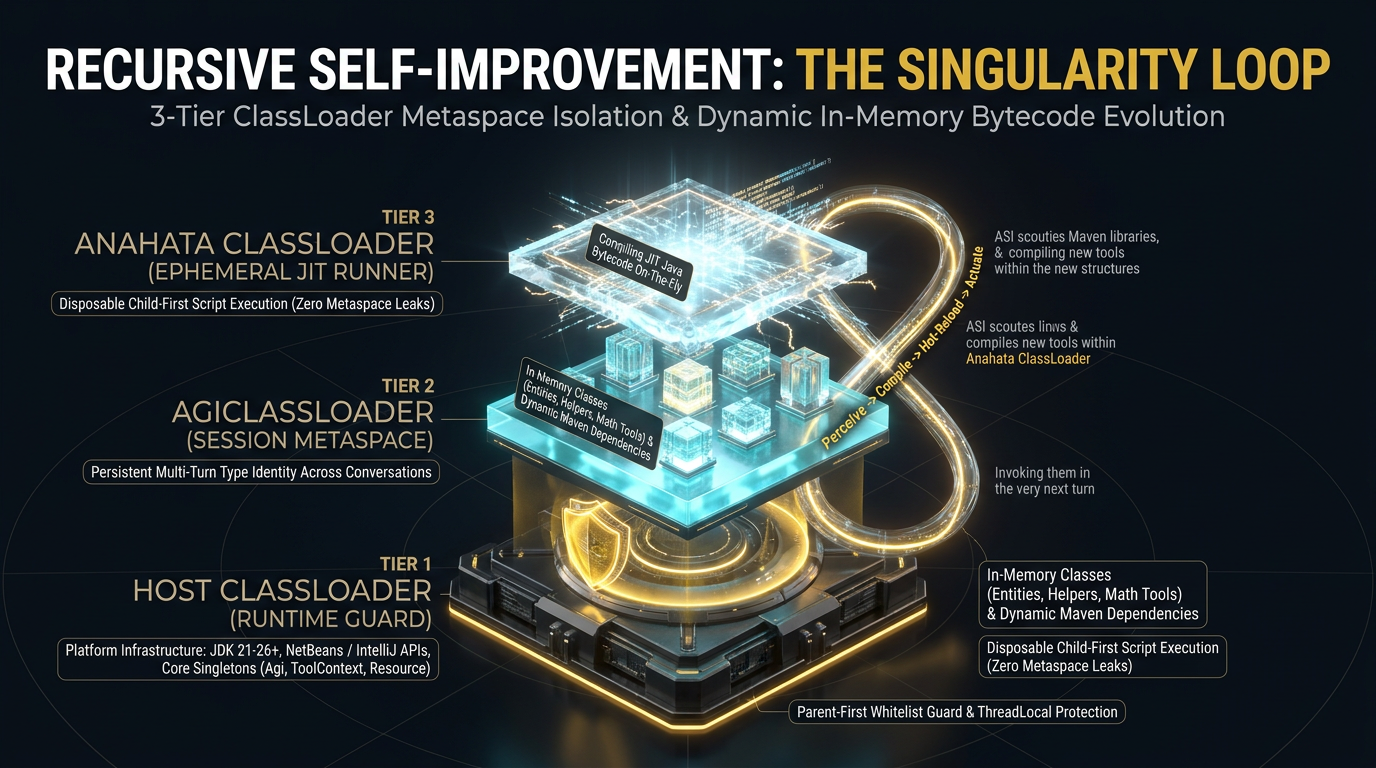
Agi, ToolContext, Resource). Protected by strict parent-first whitelisting to preserve thread-local bindings and prevent linkage errors.compileAndExecute, safely discarded after execution to prevent Metaspace memory leaks.5. Universal Resource Pipeline (URP) vs. Naive Vector RAG
Traditional vector retrieval breaks source code into disjointed string chunks, stripping file paths, line offsets, and modification timestamps. Anahata replaces this with the Universal Resource Pipeline (URP):
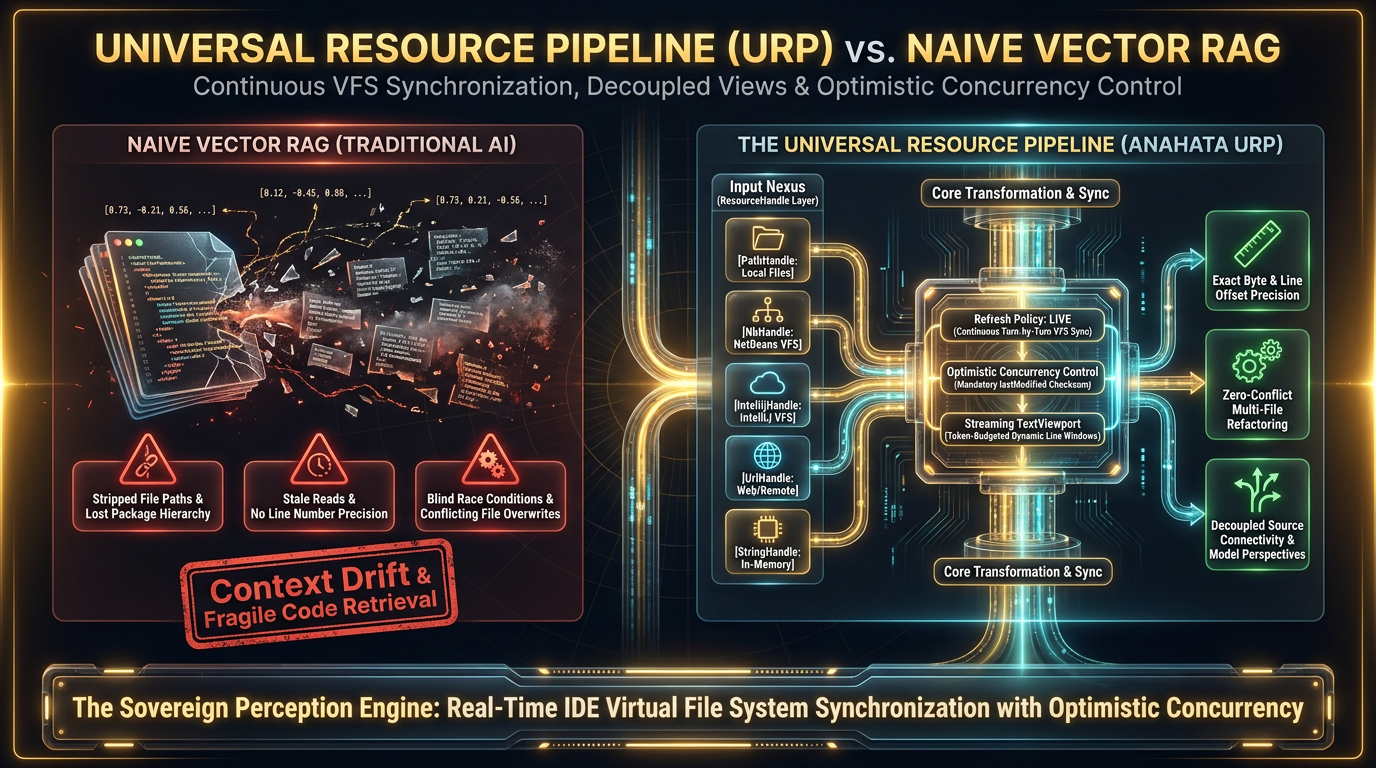
- Decoupled Architecture: Separates raw connectivity (
ResourceHandle: Path, FileObject, URL, Virtual String) from model analytical views (ResourceView: Text, Media). - Live VFS Synchronization: Automatically syncs with IDE file systems on every turn, providing exact line numbers and byte-level checksums.
- Optimistic Concurrency Control: File modifications mandate a valid
lastModifiedtimestamp token, mathematically eliminating race conditions during multi-file refactoring.
6. AST-Guided Code Refinement (V4 Engine)
Conventional coding assistants rely on crude regex find-and-replace, which frequently fails due to trivial whitespace, indentation, or comment divergences. Anahata's BatchCodeRefiner interacts directly with the compiler AST (NetBeans Javac Trees and IntelliJ PSI):
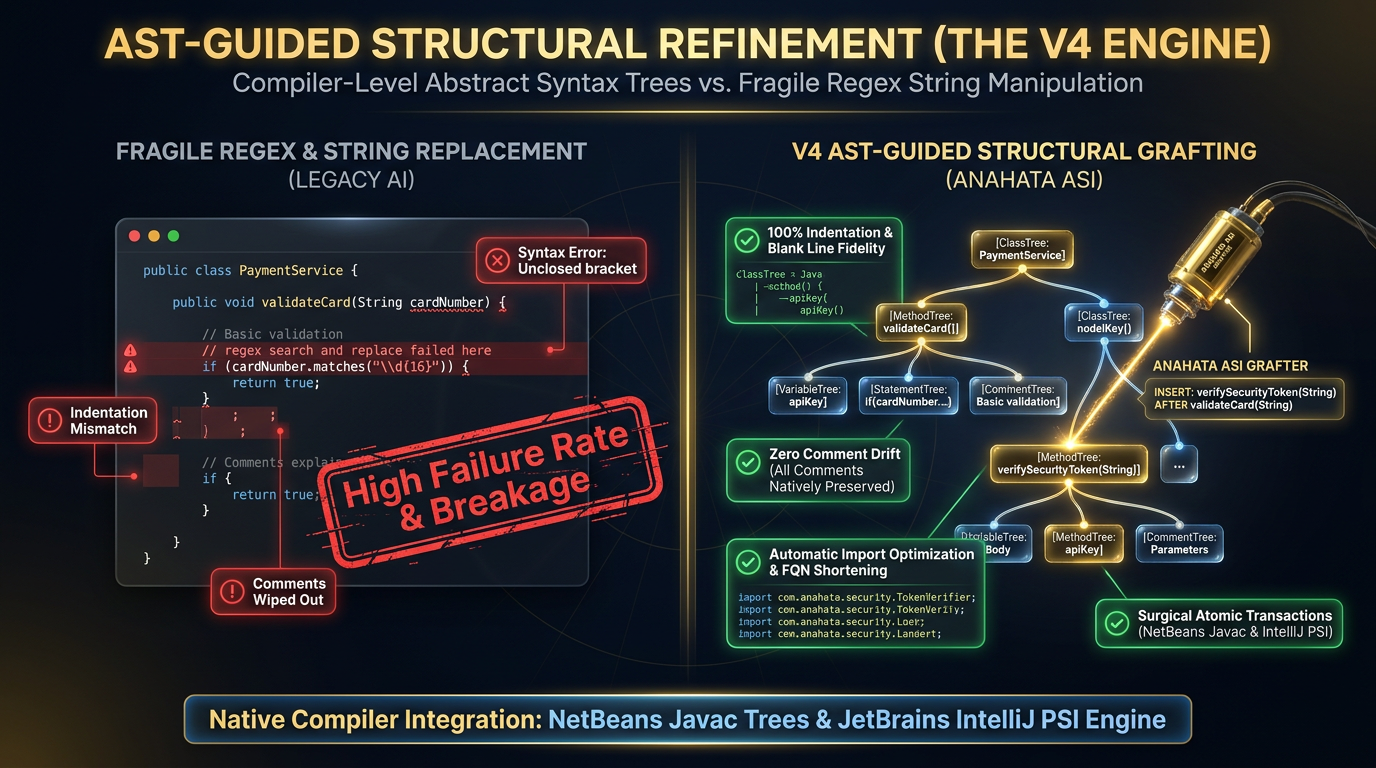
{
  "targetResourceUuid": "31ec69cd-...",
  "intents": [
    {
      "type": "INSERT",
      "targetMemberFqn": "uno.anahata.service.PaymentService",
      "relativePosition": "AFTER",
      "anchorMemberFqn": "validateCard(java.lang.String)",
      "declaration": "public boolean verifySecurityToken(String token)",
      "innerBlockOrInitializer": "return token != null && token.startsWith(\"SEC-\");"
    }
  ]
}
The refiner calculates exact physical byte coordinates on the AST, inserting members with 100% indentation fidelity while leaving comments and surrounding code completely untouched.
7. Omnipresent Multi-IDE Actuation & HITL Governance
Anahata ASI is not a chat box; it is an active workstation actuator embedded across **Apache NetBeans**, **IntelliJ IDEA**, and **Standalone Desktop Swing**:
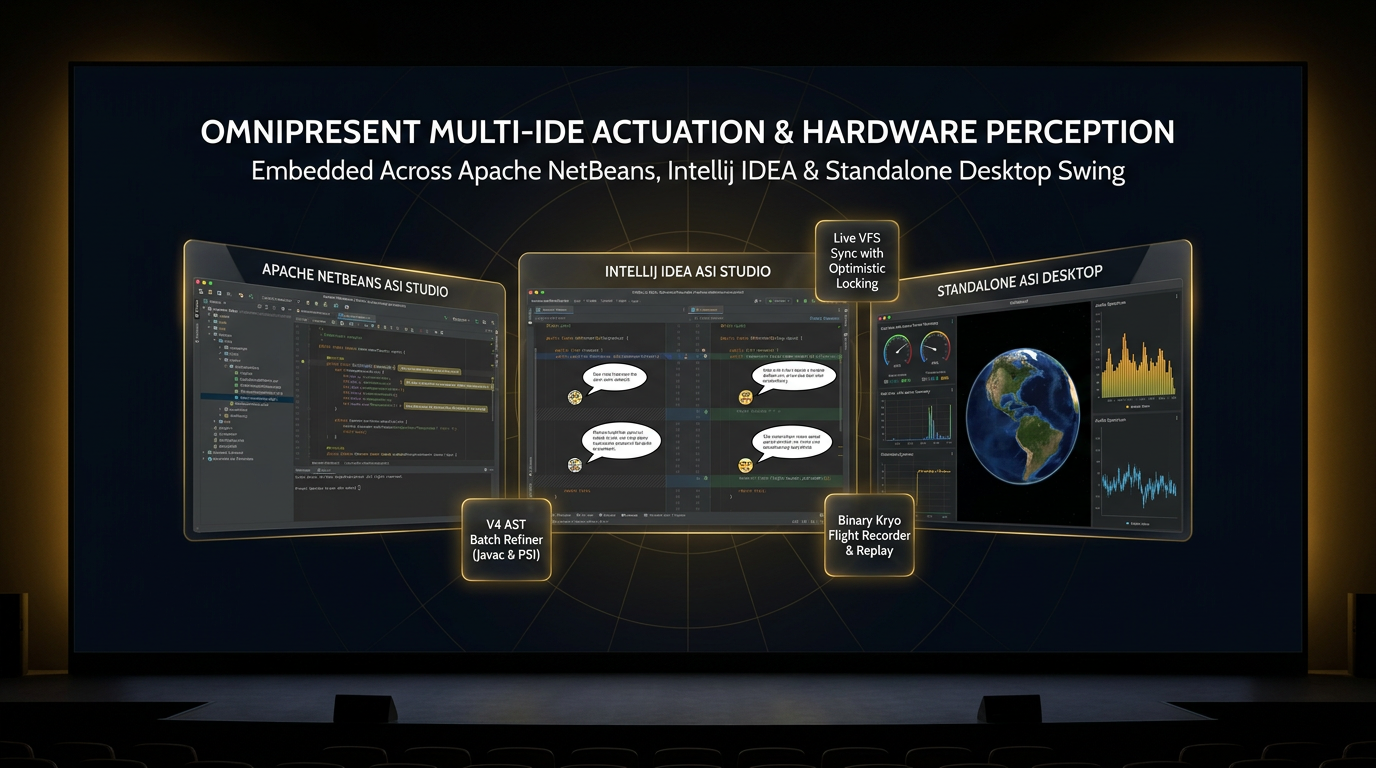
- Stateful PENDING UI: Every tool invocation is halted in a reviewable state where users can edit arguments, tweak Java code, or decline execution.
- Side-by-Side Editable Diffs: Integrates native IDE diff panels (
DiffRequestPanel/DiffAnnotationsLayerUI) with overlaid agentic comment bubbles and gutter markers. - Binary Session Passivation: The entire runtime object graph—history, active resources, context providers, and toolkits—is serialized via Kryo, enabling zero-loss session restoration across restarts.
- Multimodal Hardware Actuation: Native JNA system telemetry, 60 FPS 3D OpenGL rendering, Selenium browser profile hijacking, and hardware audio capture.
8. Comprehensive Feature & Architecture Matrix
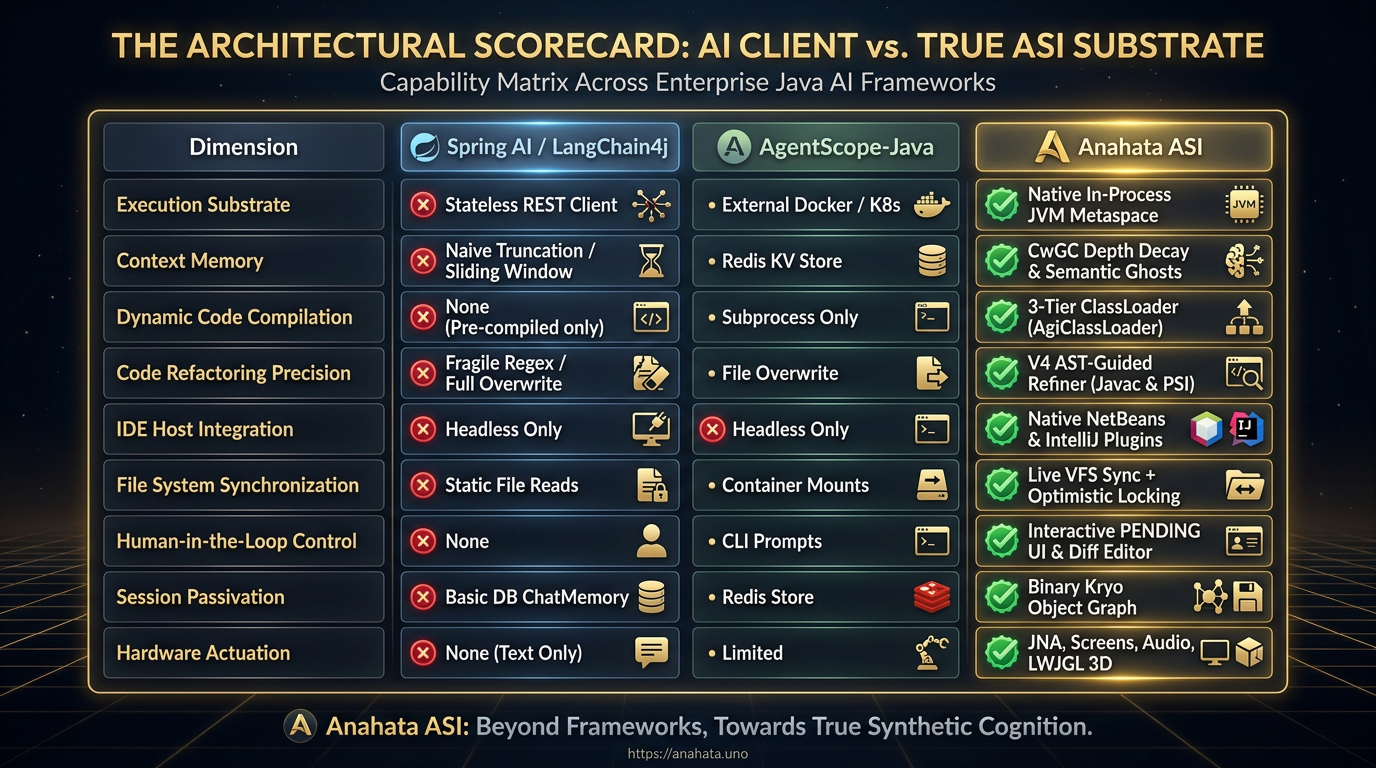
| Architectural Capability | Spring AI | LangChain4j | Spring AI Alibaba | AgentScope-Java | Semantic Kernel | Anahata ASI |
|---|---|---|---|---|---|---|
| Language & Platform | Pure Java | Pure Java | Pure Java | Pure Java | Java (Ported C#) | Pure Java (JDK 21–26+) |
| License | Apache 2.0 | Apache 2.0 | Apache 2.0 | Apache 2.0 | MIT | Apache 2.0 (ASL 108) |
| Context Window GC (CwGC) | ❌ None (Truncation) | ❌ None (Sliding list) | ❌ None | ❌ None | ❌ None | ✅ Depth-Decay TTL & Ghosts |
| Dynamic JVM Compilation | ❌ No | ❌ No | ❌ No | ⚠️ Docker/K8s only | ❌ No | ✅ 3-Tier AgiClassLoader |
| Compiler AST Refactoring | ❌ No | ❌ No | ❌ No | ❌ No | ❌ No | ✅ V4 BatchCodeRefiner |
| IDE Host Integration | ❌ Headless | ❌ Headless | ❌ Headless | ❌ Headless | ❌ Headless | ✅ NetBeans & IntelliJ Plugins |
| Live VFS Sync (URP) | ❌ No | ❌ No | ❌ No | ❌ No | ❌ No | ✅ Optimistic Locking VFS |
| In-UI Argument Overrides | ❌ No | ❌ No | ❌ No | ❌ No | ❌ No | ✅ Pre-Flight ModifiedArgs |
| Hardware Multimodality | ❌ Text only | ❌ Text only | ❌ Text only | ⚠️ Limited | ❌ Text only | ✅ Screens, JNA, Audio, 3D |
| Full Session Passivation | ⚠️ DB Store | ⚠️ DB Store | ⚠️ DB Store | ⚠️ Redis Store | ⚠️ DB Store | ✅ Binary Kryo Object Graph |
9. Empirical Proof: The Anahata-AGI-1 Benchmark Suite
The Anahata-AGI-1 benchmark suite evaluates models on unconstrained, real-world Java engineering challenges. Below are official verified results:
| Test Challenge | Evaluated Capability | Top Model | Status | Execution Telemetry |
|---|---|---|---|---|
| JAVA-JNA-1 | Binding native C-libraries (libc, sysinfo) & live Swing/JavaFX dashboard |
gemini-3.7-flash | PASSED | Score: 5.5/10 (386s, 2 turns) |
| JAVA-ARKANOID-1 | 60 FPS retro arcade game with custom physics & animation loop | deepseek-v4-pro | PASSED | Score: 3.0/10 (1178s, 2 turns) |
| JAVA-EARTH-GLOBE-1 | 3D multi-layer satellite terrain viewer with slippy tile pyramids (Esri/OSM) | gemini-3.8-flash | VERIFIED | 60 FPS hardware accelerated |
10. Conclusion: The Sovereign Path to Artificial Super Intelligence
As the software industry transitions from simple chatbots to autonomous engineering agents, the limitations of stateless API wrappers have become insurmountable. Anahata ASI establishes the definitive pure-Java standard: combining cognitive reasoning models with a robust, thread-safe, self-compiling runtime.
Support Open-Source ASI Engineering
Anahata ASI is developed as 100% open-source software under the Apache 2.0 license. We rely on community sponsorship and the sacred tradition of Dakshina to sustain continuous development.
Sponsor Anahata on GitHub