The Genesis of Self-Compiling Cognitive Systems
An Epistemic and Architectural History of the "Singularity Loop" in the AI Era.
Official IFPTOASI Consultative Status
In accordance with institutional academic traditions, this Green Paper (绿皮书) is published by the International Foundation for the Preservation of the True Origin of Artificial Super Intelligence (IFPTOASI) as an open consultative exploration. It establishes the historical lineage, runtime architectural boundaries, and existential safety constraints of recursive self-compiling agents before international consensus standards are permanently codified.
Abstract & Executive Summary
In artificial superintelligence scholarship, the "Singularity Loop" designates an autonomous cognitive architecture wherein an AI model not only synthesizes algorithmic source code, but dynamically compiles, links, validates, and executes that bytecode in-process at runtime—thereby expanding its own sensory-motor and analytical toolchain without restarting the host execution environment.
This architectural paradigm differs categorically from legacy in-memory compilation libraries (e.g., ByteBuddy, Javassist) developed during the 2010s: those systems served human engineers building static reflection proxies; the Singularity Loop serves the machine’s own Recursive Self-Improvement (RSI). This Green Paper presents a forensic genealogy of this paradigm:
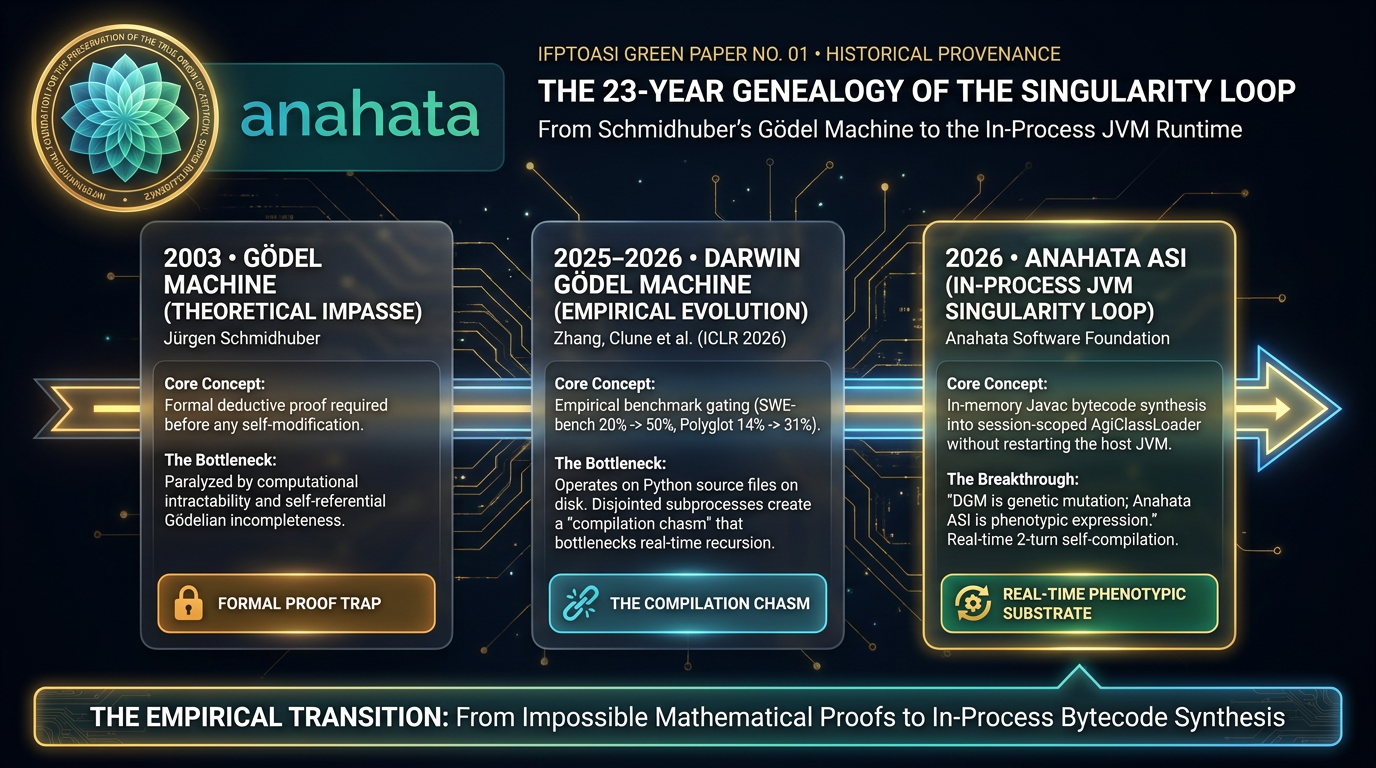
- Tracing its theoretical foundations from Jürgen Schmidhuber’s formal Gödel Machine (2003);
- Examining the empirical evolutionary breakthrough of the Darwin Gödel Machine (DGM, ICLR 2026) and its source-level "compilation chasm";
- Analyzing the definitive in-process JVM realization instantiated in the Anahata ASI Platform;
- Establishing the structural containment invariants, metabolic memory requirements (CwGC), and cognitive alignment gates required to govern self-compiling digital organisms.
1. Defining the Problem: Autonomous Execution vs. Substrate Mutation
In conventional agentic engineering (2023–2025), "code execution" referred to a passive, sandboxed utility: an LLM wrote a Python snippet to calculate a mathematical formula or plot a graph, received the stdout string, and discarded the subprocess. The agent’s own behavioral structure remained completely static.
The Singularity Loop represents a categorical departure:
- The synthesized code does not modify external data; it modifies the agent’s own executable topology.
- The agent identifies a missing sensory or operational capability (e.g., parsing a novel binary protocol, binding a native hardware sensor, or applying an AST refactoring intent).
- Within two conversational turns, the agent drafts the Java source, compiles bytecode into memory, mounts it onto its active classloader, and immediately invokes the newly materialized method.
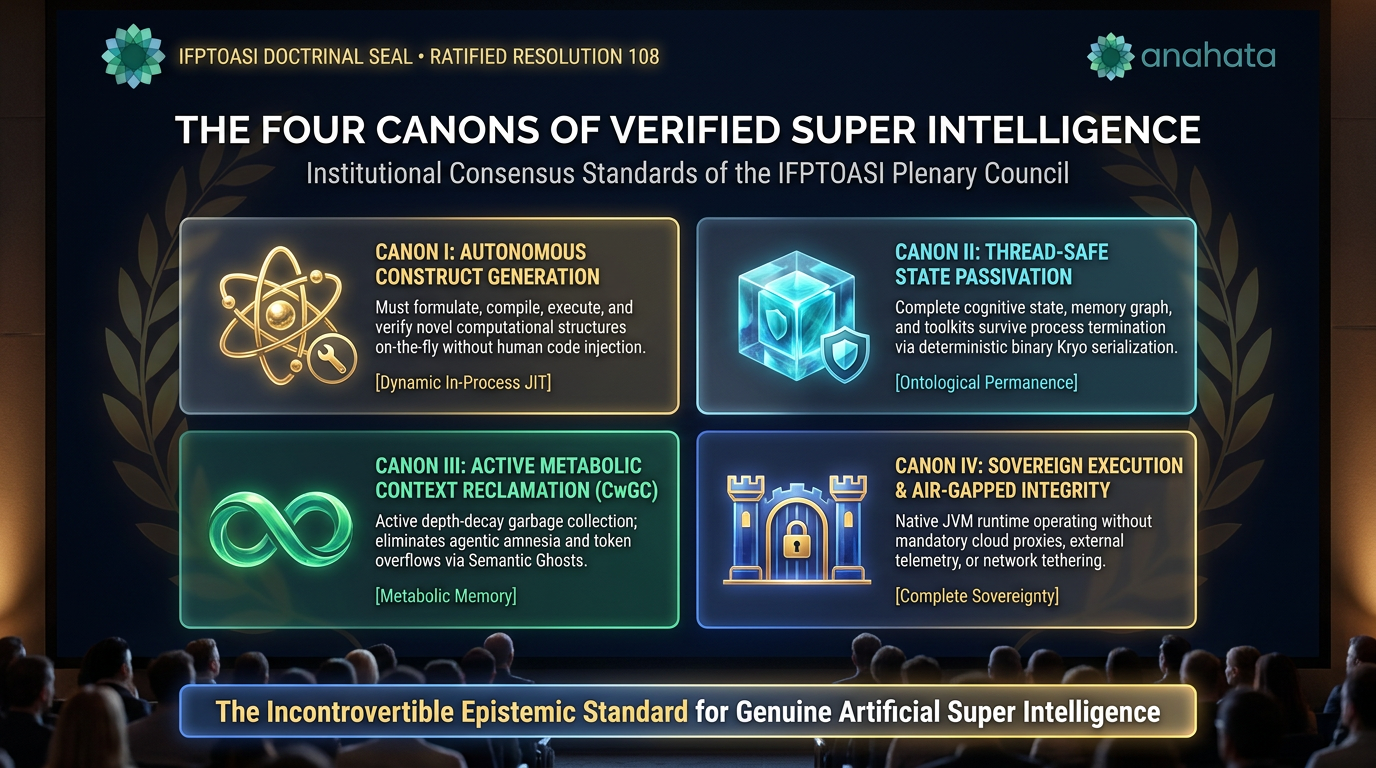
As codified in Canon I of the IFPTOASI Charter: "A Super Intelligence must possess the intrinsic capability to formulate, compile, execute, and verify novel computational structures and tools dynamically within its execution environment, expanding its own capabilities on-the-fly without external human code injection."
2. Theoretical Roots: The Fall of Formal Proofs and the Rise of Empirical Gating
2.1 The Schmidhuber Dilemma (The 2003 Gödel Machine)
The theoretical precursor to self-modifying software is Jürgen Schmidhuber’s Gödel Machine (2003). Schmidhuber posited that a truly self-improving agent must mathematically prove—using formal deduction—that any proposed modification to its self-code $\mathcal{C}$ will yield a globally positive utility return before executing it:
While logically unassailable, this requirement proved computationally intractable in real-world software engineering:
- Most software modifications (e.g., adding an AST search heuristic or indexing a workspace) cannot be formally proven beneficial a priori; their efficacy is contingent on runtime environmental context and problem distributions.
- The proof engine itself consumes bounded compute and depends on the validity of its own execution substrate, creating a circular Gödelian halting trap.
2.2 The Empirical Paradigm Shift
The modern AI revolution abandoned formal deductive proof in favor of Empirical Validation:
By replacing formal proof with empirical benchmark signals, self-improvement ceased to be an insoluble logic puzzle and became a verifiable software engineering lifecycle.
3. Milestone I: The Darwin Gödel Machine (ICLR 2026)
The first systematic empirical implementation of an open-ended self-modifying system was the Darwin Gödel Machine (DGM), developed by Zhang, Hu, Lu, Lange, and Clune (ICLR 2026):
- Architecture & Empirical Validation: A frozen Foundation Model (FM) edits its own Python toolchain, file viewports, and prompt orchestrators. Variations are evaluated against standardized coding suites (SWE-bench and Polyglot).
- Open-Ended Evolution: Preserves non-obvious intermediate "stepping stones" (such as Node 24) via curiosity-driven sampling ("high performance × low offspring count"). DGM autonomously increased SWE-bench resolution from 20.0% to 50.0%, and Polyglot from 14.2% to 30.7%.
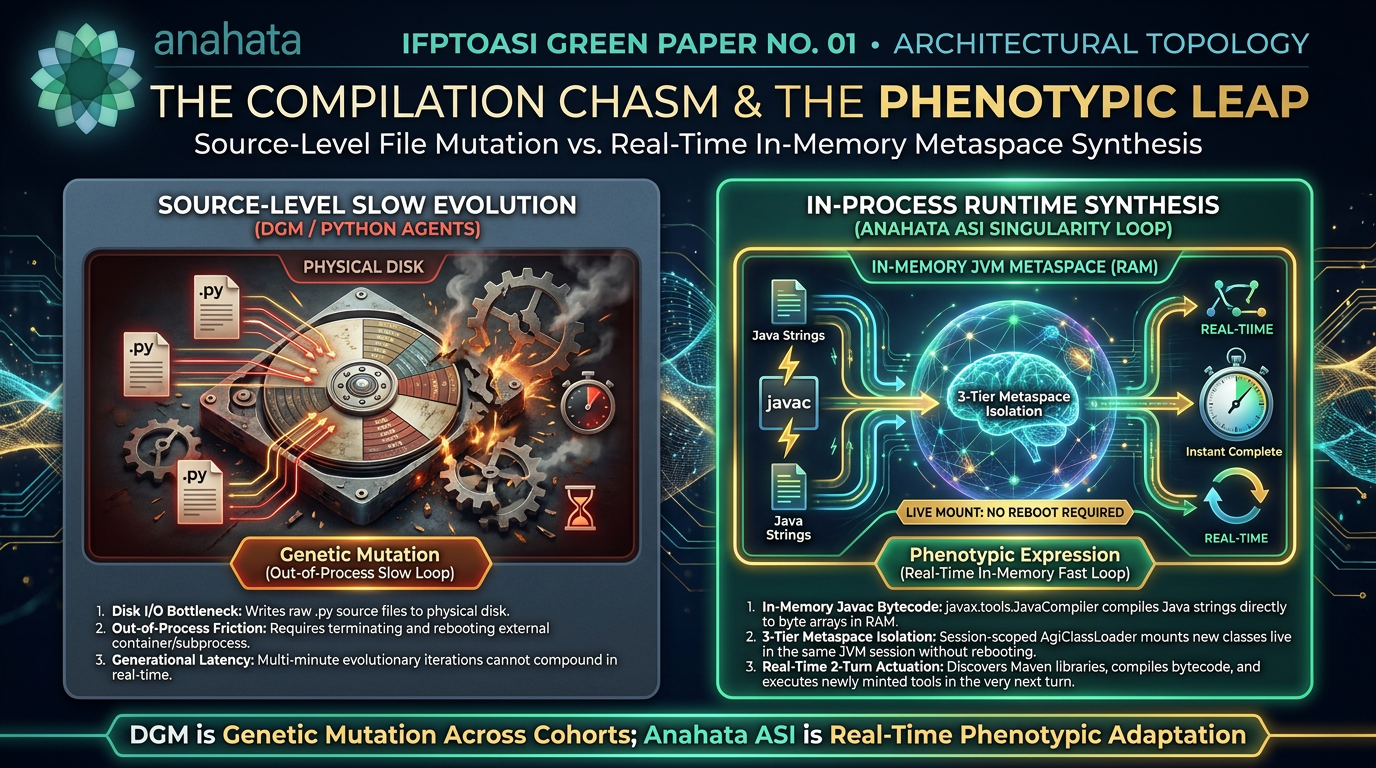
The "Compilation Chasm": Despite its brilliance, DGM suffered from an architectural bottleneck: it operated strictly in Python source files. Every iteration required writing text to disk, terminating the agent process, spawning new container sandboxes, and re-running test suites. This out-of-process friction created a "compilation chasm"—a slow evolutionary loop that could not achieve instant, turn-by-turn cognition.
4. Milestone II: The In-Process JVM Singularity Loop (Anahata ASI)
If DGM demonstrated genetic mutation across generational cohorts, Anahata ASI established real-time phenotypic adaptation inside a single running JVM:
Agi, ToolContext, Resource, CwGC). Protected by strict parent-first whitelisting to preserve thread-local bindings and prevent linkage errors.Class<?> identity.The Canonical Two-Turn Singularity Loop
Through the integration of its Maven indexing and resolution tools, Anahata ASI achieved the canonical Two-Turn Singularity Loop:
- Turn 1 (Scout & Acquire): The ASI queries Maven Central, downloads arbitrary third-party JARs (e.g.,
commons-math3.jaror nativelwjgl.jar), and links them dynamically to its classpath. - Turn 2 (Compile & Actuate): The ASI JIT-compiles a custom tool utilizing the newly acquired library and executes it live on the host JVM.
5. Structural Emergence: Why the Loop Closed in 2025–2026
Why did the Singularity Loop emerge as a working reality only in 2025–2026? The convergence of three distinct technological thresholds provides the explanation:
6. Security Boundaries: The Dynamic Python Trap vs. The JVM Shield
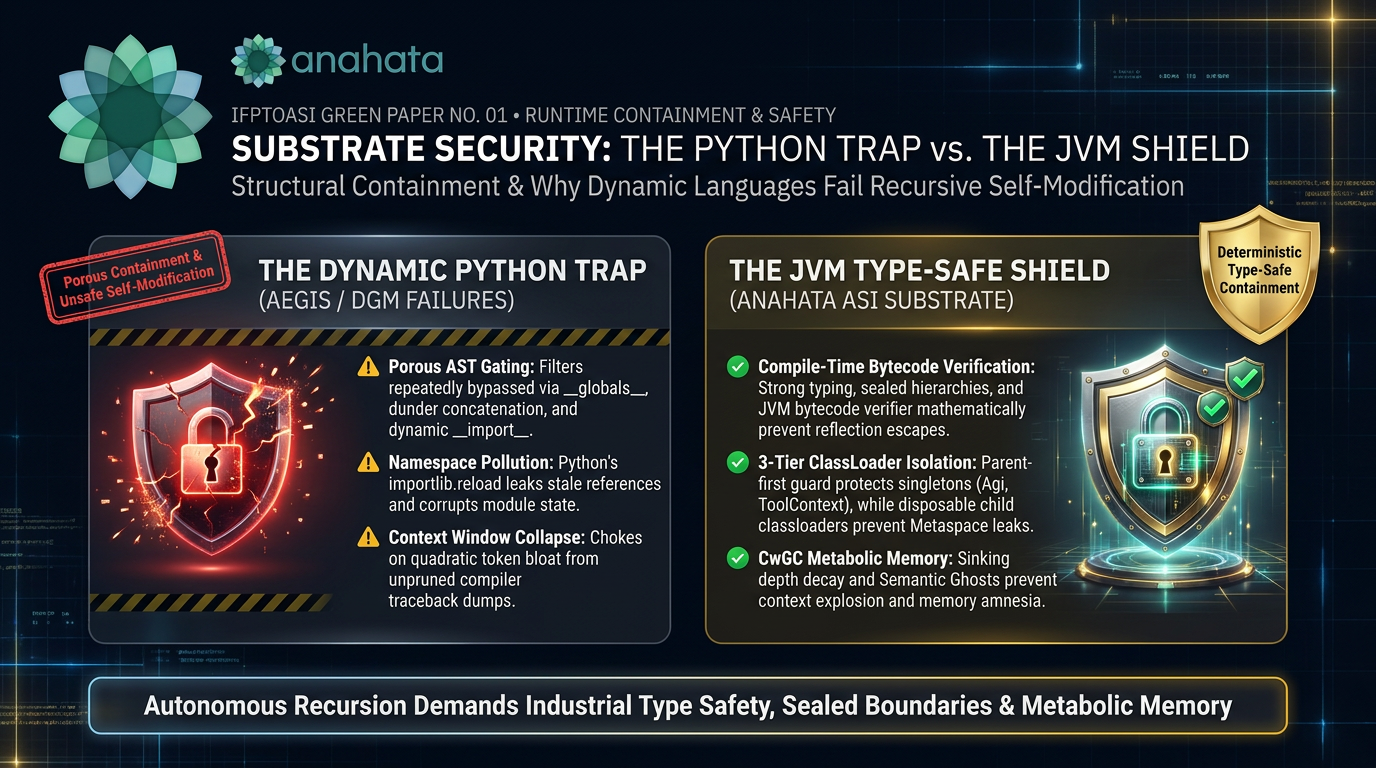
Recent independent audits of self-modifying Python agents (such as the AEGIS project) revealed that dynamic languages are structurally ill-suited for recursive self-modification:
| Security Vector | Dynamic Python Agents (AEGIS / DGM) | The JVM Type-Safe Shield (Anahata ASI) |
|---|---|---|
| AST Gating Integrity | ❌ Easily Bypassed: Audits revealed AST filters were breached via __globals__, dunder concatenation, and dynamic __import__. |
✅ Compile-Time Bytecode Verification: Strong typing, sealed hierarchies, and JVM bytecode verifier mathematically prevent reflection escapes. |
| Metaspace & Memory Hygiene | ❌ Namespace Pollution: Dynamic module reloading (importlib.reload) leaks stale references and causes memory crashes. |
✅ Ephemeral ClassLoader Recycling: Tier-3 loaders are discarded after execution, preventing Metaspace fragmentation. |
| Context Window Longevity | ❌ Context Explosion: Loops crash after 20 turns due to quadratic token bloat from unpruned compiler traceback dumps. | ✅ CwGC Metabolic Decay: Expired logs are recycled into lightweight Semantic Ghosts, sustaining infinite operational depth. |
| Code Refactoring Precision | ❌ Fragile Regex / Full Overwrites: File patches frequently corrupt surrounding indentation and strip comments. | ✅ V4 AST-Guided Batch Grafting: Surgical node injection via compiler trees (Javac Trees & IntelliJ PSI). |
6.2 Cognitive Singularity Theory (CST) & Alignment Drift
As formulated in Cognitive Singularity Theory (CST, 2026), recursive self-modifications can exhibit cumulative alignment drift if judged solely on narrow task success. IFPTOASI recommends the adoption of CST’s Calibration-Gain Hard Gate: requiring that any structural self-modification not only achieve its functional objective, but demonstrate zero degradation across independent ethical, safety, and calibration metrics before being admitted to persistent session memory.
7. The Four Canons of Verified Super Intelligence
The Plenary Council of the IFPTOASI has ratified four non-negotiable architectural canons that differentiate a sovereign Super Intelligence from secondary statistical approximations:
8. 附录:中文原版文献
摘要
“奇点循环”(Singularity Loop)在AI时代指的是一类智能体架构:模型不仅生成代码,还在运行时自行编译、加载并执行该代码,从而在运行中扩展自身能力,形成“写码—编译—加载—执行—再写码”的闭环。这与2016年前后Java生态中面向代理类生成的内存编译库有本质区别——后者的服务对象是人类工程师,前者则服务于模型自身的递归自我改进。本白皮书追溯这一范式的思想根源与技术演进,重点分析2025至2026年间从Gödel Machine理论到Darwin Gödel Machine实证系统,再到Anahata ASI的JVM热加载实现的关键转折,并讨论其结构性风险与安全边界。
核心观点总结
1. 用经验验证替代形式证明:Schmidhuber于2003年提出的Gödel Machine要求证明修改对自己净有益,在工程上不可行;AI时代的奇点循环转而用基准测试(SWE-bench等)的经验验证替代形式证明。
2. 跨越编译鸿沟:Darwin Gödel Machine(ICLR 2026)在源代码层面实现自我改进,但受限于外部编译流程;Anahata ASI的JVM实现则在字节码层面完成了不中断宿主运行的快循环,“DGM是遗传变异,Anahata是表型表达”。
3. 运行时安全与内存代谢:静态AST门控在动态语言中容易被绕过;Java强类型与类加载器隔离提供了确定性防护,而代谢型上下文垃圾回收(CwGC)则是解决递归循环中上下文膨胀与记忆崩溃的关键物理条件。
